Aarav Reddy
Johns Hopkins · BME + EE
NGO experience and product building, with three published computer-science papers in IEEE and Springer venues.
 banyan.
THE BANYAN PITCH
Connect what nonprofits learn
to what funders decide.
01 / THE PROBLEM
Reports sit in one place. Spreadsheets sit in another. A nonprofit facing the same question starts again.
While working on childhood-cancer awareness in India, co-creator Aarav Reddy faced a difficult question: how could his project support families beyond treatment—through transport, lodging, or education?
Had another organization already learned something that could guide that decision?
02 / THE PRODUCT
Two workflows. A shared commitment to evidence.
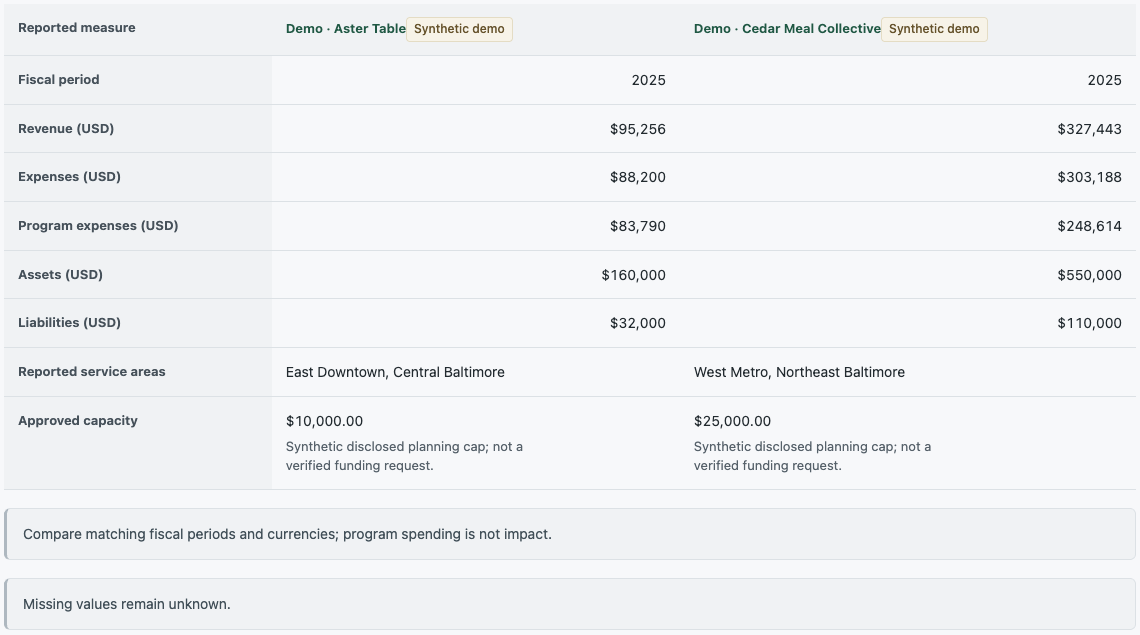
Search locally, compare nonprofit records, and draft a funding plan with the supporting sources beside it.
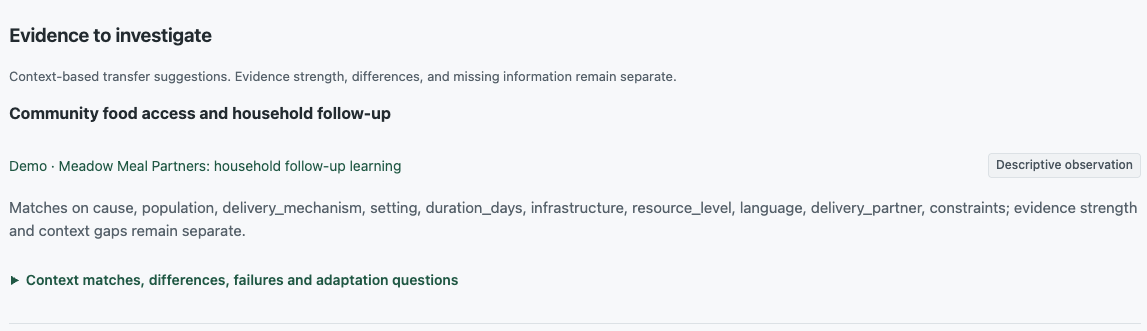
Find lessons from similar programs, examine the context, and decide what is worth testing in your own setting.
Follow a claim back to its supporting record.
A result from one setting may not transfer to another.
Nonprofits control permissions for contributed evidence.
A PRACTICAL START
Begin with a spreadsheet. Check the mapped fields, review the result, and choose what to share. Adoption and ease of use still need to be tested with real participants.
Start with existing program summaries and records.
Review mapped fields, definitions, and missing information.
Use the evidence and set permissions for further use.
03 / THE BUSINESS MODEL
We propose an annual foundation-team subscription for research, reporting, and monitoring. Funders could later sponsor nonprofit onboarding.
Payment would never buy a higher rank.
$6,000per foundation team / year
Pricing and willingness to pay are unvalidated. Billing and donation transfers are not built.
A FOCUSED FIRST MARKET
Local funders have a natural reason to compare organizations and understand community needs. We would test the reachable, suitable subset first.
community foundations operate in the United States, according to the Council on Foundations.
An illustrative 900-account scenario at the proposed price, not a sales forecast or validated addressable market.
Candid already provides nonprofit and funder research. Banyan’s focus is connecting that research to context-rich lessons nonprofits choose to share. This describes our focus, not an exclusive capability claim.
04 / PROGRESS & THE NEXT PROOF
funder to sponsor
a focused local trial
nonprofits to contribute
and test the workflow
These are pilot targets, not enrolled participants or confirmed funding.
We have begun conversations with four student-led organizations as we prepare for our first pilot.
We have also begun conversations with Maryland Food Bank about a possible free trial. These discussions are at an early stage; a pilot has not yet been confirmed.
05 / THE TEAM
Johns Hopkins · BME + EE
NGO experience and product building, with three published computer-science papers in IEEE and Springer venues.
Johns Hopkins · CS + Cognitive Science
Venture scouting through RECON by FORGE.
PROPOSED EXPANSION
Test a Baltimore food-security pilot and document useful decisions.
Try another city and cause, guided by participant feedback.
Work with local partners, country-specific sources, permissions, and review.
THE NEXT STEP
We are seeking introductions to a foundation and local nonprofits for a first pilot.
Our pricing, revenue scenarios, pilot targets, and expansion plans are proposals to test with participants. The demo uses synthetic data; it does not demonstrate real-world impact.
Market and sector references: Council on Foundations — community foundations; Candid — nonprofit and funder research.